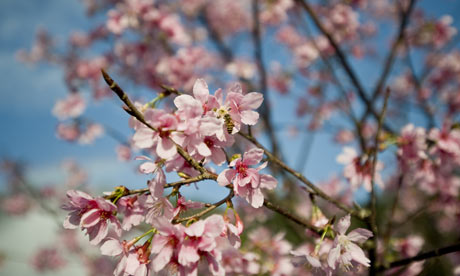
Japanese cherry blossom. Photograph: Dan
Chung
In Japan, tracking the cherry blossom is a national obsession, while in the
US pilgrims hunt for the brightest shows of autumnal colours.
Today the National Trust is revealing the British version: a festival to celebrate fruit tree blossom as it sweeps across the country.
Springtime may still feel a long way off, but the Trust is hoping to cheer people up with its Full Bloom project. Nature lovers will be encouraged to visit orchards as they come into bloom and send in images of what they find.
The festival will start in Cornwall's Tamar Valley, home of the Trust's mother orchard, in April. Planted in 2007, the mother orchard consists of 270 trees with 120 varieties typical to Cornwall and Devon, growing on an eight-acre plot. The idea is to grow these trees to adulthood to make sure they are not lost, and then create more trees from them and reintroduce the rare ones to orchards and gardens.
Some of the varieties here were down to their last few trees; others with glorious names like the Pig's Snout were thought to be extinct but were found hiding away in the corner of kitchen gardens.
The focus of the festival will shift northwards, ending in May at Acorn Bank in Cumbria, which has a formal orchard within a walled garden and a large perry pear orchard.
As well as Cotehele and Acorn Bank, the Trust has spectacular orchards as far afield as Somerset, Kent and the Midlands but it is also involving groups such as the Common Ground campaigners, which has long fought for the future of orchards, and the increasing number of groups who are creating new community orchards.
Conservationists hope the blossom festival will also raise attention to the dire plight of the orchard in some regions. Last harvest-time environmental experts and campaigners warned traditional orchards could vanish from the British landscape by the end of the century unless action is taken to save them.
Natural England and the National Trust claimed 60% of England's orchards had disappeared since the 1950s, as they launched a £500,000 project aimed at halting the decline. The crisis has been even worse in some areas, such as Devon, which has lost almost 90% of its orchards.
In Japan the progress of the cherry blossom makes nightly television news. Merry knows the Trust's answer is unlikely to attract such attention, but "with all this wintery weather around, it's something to look forward to", she said.
Today the National Trust is revealing the British version: a festival to celebrate fruit tree blossom as it sweeps across the country.
Springtime may still feel a long way off, but the Trust is hoping to cheer people up with its Full Bloom project. Nature lovers will be encouraged to visit orchards as they come into bloom and send in images of what they find.
The festival will start in Cornwall's Tamar Valley, home of the Trust's mother orchard, in April. Planted in 2007, the mother orchard consists of 270 trees with 120 varieties typical to Cornwall and Devon, growing on an eight-acre plot. The idea is to grow these trees to adulthood to make sure they are not lost, and then create more trees from them and reintroduce the rare ones to orchards and gardens.
Some of the varieties here were down to their last few trees; others with glorious names like the Pig's Snout were thought to be extinct but were found hiding away in the corner of kitchen gardens.
The focus of the festival will shift northwards, ending in May at Acorn Bank in Cumbria, which has a formal orchard within a walled garden and a large perry pear orchard.
As well as Cotehele and Acorn Bank, the Trust has spectacular orchards as far afield as Somerset, Kent and the Midlands but it is also involving groups such as the Common Ground campaigners, which has long fought for the future of orchards, and the increasing number of groups who are creating new community orchards.
Conservationists hope the blossom festival will also raise attention to the dire plight of the orchard in some regions. Last harvest-time environmental experts and campaigners warned traditional orchards could vanish from the British landscape by the end of the century unless action is taken to save them.
Natural England and the National Trust claimed 60% of England's orchards had disappeared since the 1950s, as they launched a £500,000 project aimed at halting the decline. The crisis has been even worse in some areas, such as Devon, which has lost almost 90% of its orchards.
In Japan the progress of the cherry blossom makes nightly television news. Merry knows the Trust's answer is unlikely to attract such attention, but "with all this wintery weather around, it's something to look forward to", she said.

 Did you ever notice that most women have friends, but few
of us have been educated on how to grow and cultivate friendships that nourish,
grow deeper over time and ultimately give more than they take? Even if we have
friends we’ve known for years, or we have a lot of friends in number, most women
lack – and crave – deeper soul sister connections. In my work with women around
the world as a coach and relationship expert, I hear again and again how lonely
women are for meaningful, truly supportive friendships, or how often they hang
onto the wrong friendships, just like staying in the wrong romantic
relationship, and so there is no space for new buds to come in.
Did you ever notice that most women have friends, but few
of us have been educated on how to grow and cultivate friendships that nourish,
grow deeper over time and ultimately give more than they take? Even if we have
friends we’ve known for years, or we have a lot of friends in number, most women
lack – and crave – deeper soul sister connections. In my work with women around
the world as a coach and relationship expert, I hear again and again how lonely
women are for meaningful, truly supportive friendships, or how often they hang
onto the wrong friendships, just like staying in the wrong romantic
relationship, and so there is no space for new buds to come in.